
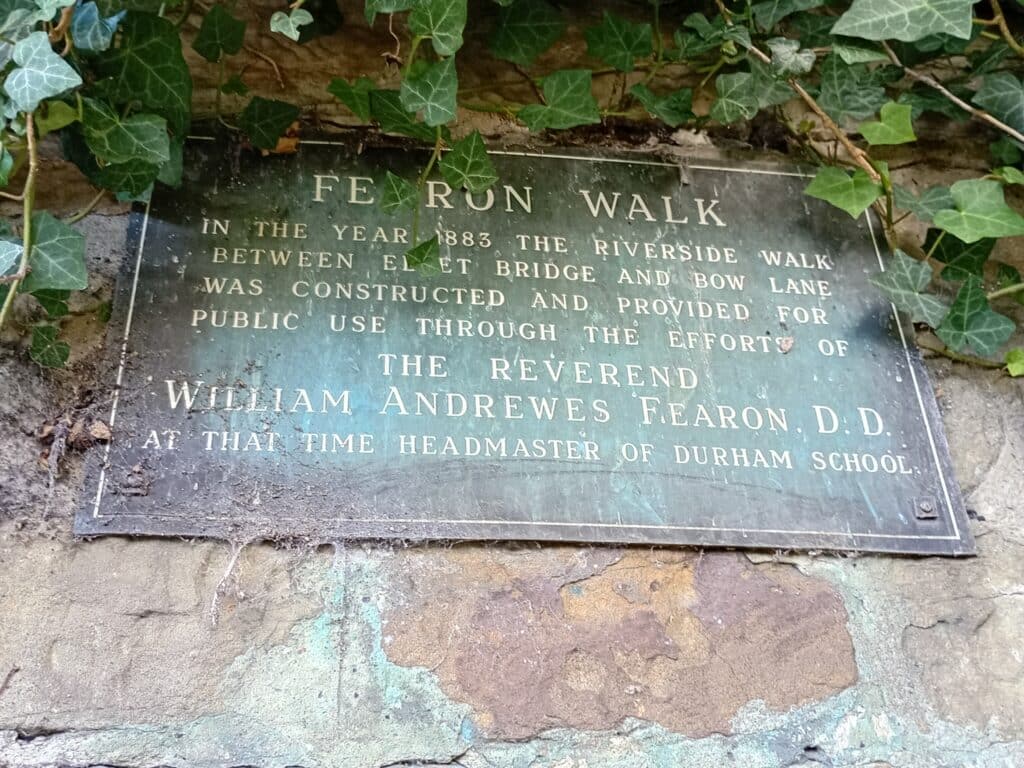
I was surprised to read in a BBC article published last Saturday that a new discovery had been made within Durham. A group of volunteers from the Durham City Riverscape Community had found during one of their monthly litter picks a sign not far from Elvet Bridge. Although covered in ivy, upon cleaning it the following message was revealed:
FEARON WALK
In the year 1883 the Riverside Walk between Elvet Bridge and Bow Lane was constructed and provided for public use through the efforts of
THE REVEREND WILLIAM ANDREWES FEARON D. D. at that time Headmaster of Durham School.
The walk itself starts at Elvet Bridge, initially bound by two stone walls on either side before breaking into a traditional footpath. It hugs the curve of the river Wear, running parallel with Saddler Street above before culminating in Bow Lane and Kingsgate Bridge.
While the name of ‘Fearon Walk’ was news to the volunteers who uncovered it— colloquially it is known only as the Riverside Walk— the name is itself recognised within Durham School and in official local literature.
William Fearon himself was only headmaster from 1882 to 1884, but was a very active and productive one during his limited time here. A article on Durham University rowing by Captain A.A. Macfarlane-Grieve, published in 1922 as part of A History of Durham Rowing, mentioned the “new concrete path” commissioned by Fearon, observing that “Before this date, it had been necessary for those running with the boats to cross the river at Elvet Bridge, and then proceed by way of New Elvet to the river bank at St. Oswald’s Church, which made coaching from the bank a much more difficult undertaking than it is at present.” J.G. Burrell, who outlined the history of the Durham Amateur Rowing Club in the same volume, also observed the following:
“At a meeting held in March, 1884, the Honorary Secretary was instructed to forward a vote of thanks fromk the Officers and members of the Club to the Rev. W.A. Fearon, M.A., Headmaster of Durham School, for his great generosity in building the wall and constructing a footpath below Hatfield Hall and connecting Elvet Waterside with that part of the banks known as Bow Corner. Present rowing men can hardly realize what the conditions were, both for coaching and following the long course races, before this useful walk was completed. Residents, other than those interested in rowing, have certainly reaped the benefit of this convenient and pleasant walk along the river.”
Not only was there a Fearon Walk, those who visit Winchester College will find ‘Fearon’s Corner’. “But there is no spot in the school premises at Durham which could be called Fearon’s corner, for there is no one corner which rather than another might claim such a title. The external results of his two years Head-mastership are to be seen over the whole extent of the School-grounds,” observed the 1884 Dunelmian.
In his time as Head, he was able to enlarge and level the playing field, as well as install an open-air swimming bath. Other additions to the school included a carpenter’s shop, music and drawing room, the expansion of the School Library, and the creation of the new science
buildings—although the science block would only be opened the term after Fearon’s departure. This was indicative of what the Dunelmian in 1884 called his “wide-reaching, unsparing energy, a wonderful power of work, an indomitable vigour [which] was one of the chief characteristics of that glorious two years.” He also taught at a Fifth and Sixth Form level, occasionally providing guidance to the lower classical forms and three Mathematical Divisions. He also provided periodical examinations of the whole school, which must have been a large amount of labour. The Dunelmian continues: “He examined the ordination candidates at Newcastle, preached here, there, and everywhere, went everywhere, and did everything: now reading a paper at a Diocesan conference, now giving away at the prizes at the Gateshead Girls’ High School, now working to found a similar school in Durham. ‘Work,’ he said, preaching in the Cathedral, ‘is the only beautiful, as it is the only natural state of existence.’” Fearon’s introduction of the Science Department was out of a belief that to grow towards the future, Durham School must expand from its classical roots.
This mindset of the importance of work is seen elsewhere in Fearon’s career. Before coming to Durham School, he had served as Assistant Master at Winchester College from 1868 to 1882; after completing his two years as Headmaster in Durham School, he returned to Winchester in 1884 where he served as Headmaster until 1901. By then, he was regarded sufficiently highly that the Board of Governors at Winchester did not need to interview him. His geniality and ambitious nature gained him the nickname of ‘the Bear’. He concluded his career in the role of Archdeacon of Winchester, a post he served from 1901 until his death in 1924. Having spoken to former teachers at Winchester, I am left with the impression of someone whose insight into the future and sense of hard work dramatically changed the institutions he was associated with.