
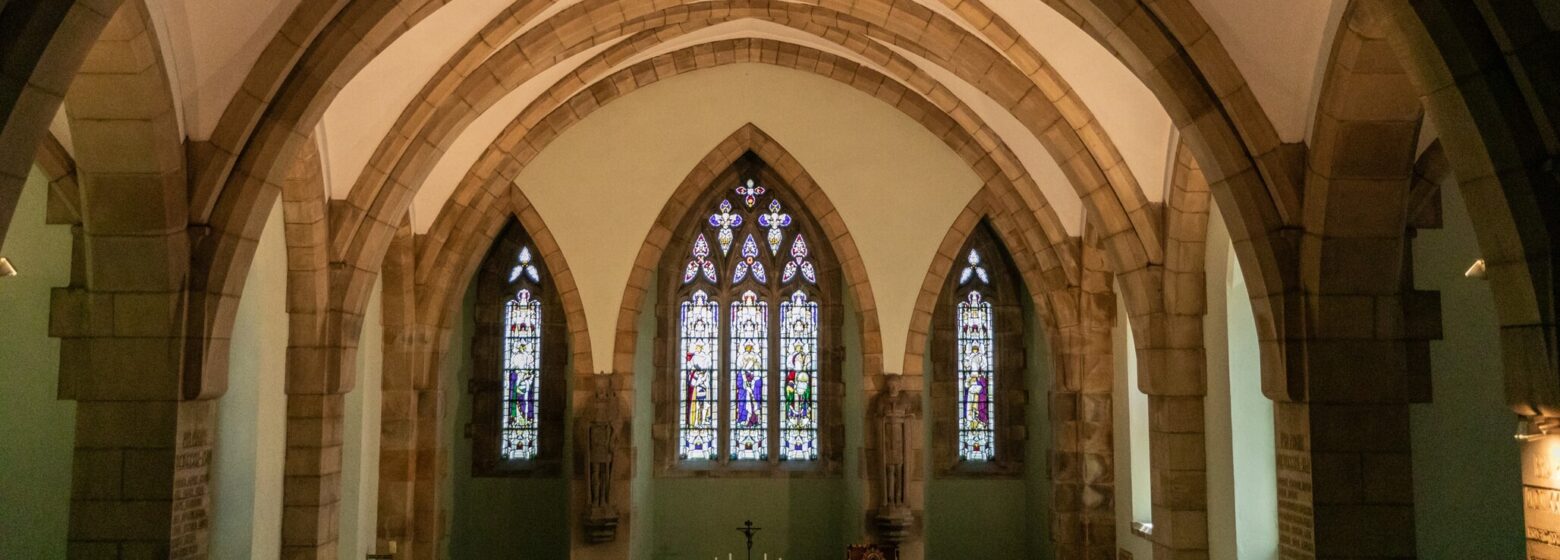
Last week, I was fortunate enough to visit Harrison & Harrison, the Durham-based organ builders who have had such a long history with the School. The organisation kindly donated to the School on indefinite loan a collection of papers and correspondence from Henry Shaw Harrison, a former partner of Harrison & Harrison. Henry attended Durham School from 1883 to 1887, but more crucially he was a key part in constructing the chapel, being the Honorary Secretary of the Sub-Committee dedicated to the Memorial Chapel. His papers loaned to the School provide a complete picture of the Chapel’s development from 1923 to 1926, with elements that have not hitherto been presented to the public. Suffice to say, Harrison was forced to combat a multitude of issues and setbacks before the Memorial Chapel was completed.
One of the earliest issues that the School came across was the selection of a architect. The Memorial Chapel Committee decided on a limited list of several architects—of which nine were Old Dunelmians—to privately write to, with the results being judged by an independent party. Walter Brierley of York was twelfth on the list. At this point, something went awry. The Architect’s Journal had, unbeknownst to the School, published (incorrectly) that the competition was an open one, and soon Mr Harrison and Mr Budworth were buried under a deluge of letters from all local architects seeking the prize. A letter from Harrison to one of the selected architects on the 27th January 1923 expressed “some surprise” at the offending paragraph. “This has been inserted without any authority of the Committee for the competition is strictly limited and by invitation only.” In a letter sent to the Architect’s Journal of the 8th May 1923, Harrison vents his ire
“I feel I have been suffering quite a serious grievance at your hands. [I stated] that we were inviting selected architects and that there was no open competition. But the next issue of your journal contained a notice of our proposal with my name as the Hon. Secretary. What was the result? I was inundated with applications from all over England which, while showing the far-reaching range of your publication, increased my as secretary’s work some four or five times. Do you not think there was reason for my annoyance and justification for my thinking all sorts of unkind things about you?”
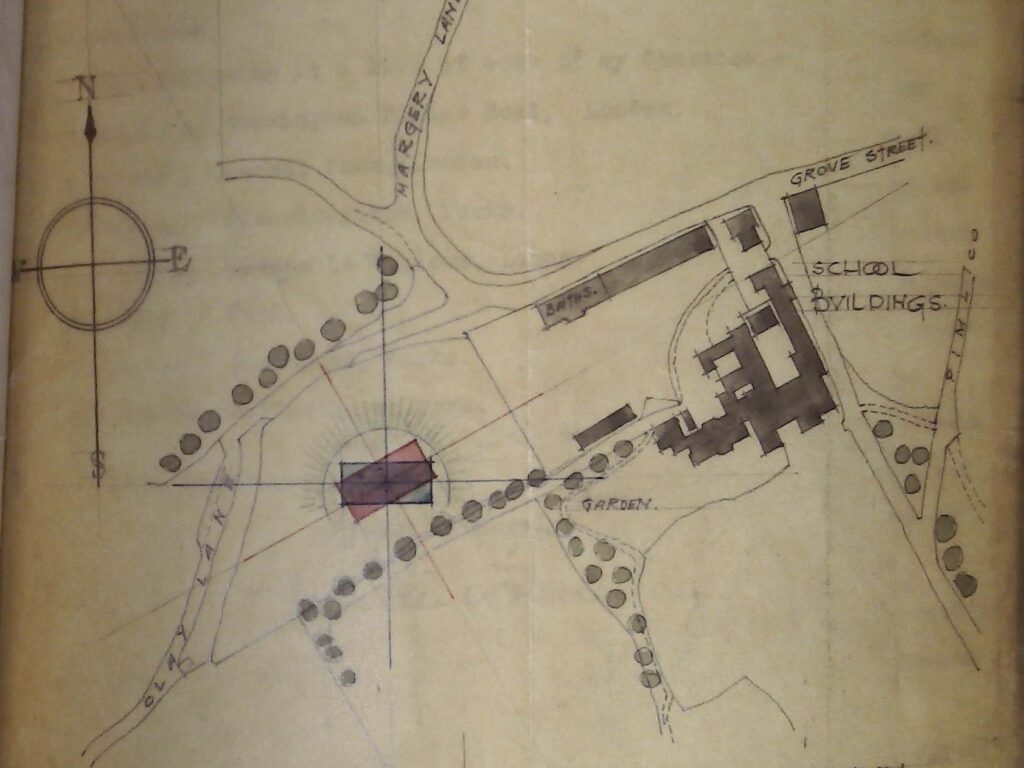
Walter Brierley’s design was eventually selected, and he began working straight away. Much of his design choices were sensible. The chapel was originally designed to be lie exactly East to West, and it was Brierley’s idea to have it in line with the rest of the school buildings, rather than at a strange angle. The project soon befell a different issue, however; in March 1924, before work could begin, the Chapel was threatened by the local County Council’s plan to build a road around the rear of the school which would (to quote Harrison) “go clean through the site”. Harrison wrote in great haste to Brierley to get the chapel plans submitted to the council. Brierley responded, “the proposal to cut a road over the top of Observatory Hill is unthinkable, and will surely not be tolerated. Apart from all other reasons it seems to me a mad scheme from an engineering point of view. It is surprising what people think of for the unemployed!” Much work was done in “fighting against the wicked road scheme”, especially as no tender could be put down for work on the Chapel while the road was still a
possibility. This was in March; it was not until 13th May 1924 that a relieved Brierley was able to announce that “the proposed ‘monstrous road’ is I assume ‘scotched’ for I have now received notice of approval of the plans from the City Council”. A painting of the planned chapel was produced to give an impression of the completed version, although it was noted that “the wind blown elongated schoolboys and their Master on the terrace don’t fit the picture”.
The laying of the foundations on the 3rd July 1924 was hindered by the quantity of “soft rotten vegetable matter” at the top of the hill. I was surprised to learn that, upon the placement of the foundation stone on the 3rd July 1924, a time capsule was placed underneath it: a “square faced pickle bottle” sealed with wax that contained a description of the building, a daily newspaper and a coin of the realm.
Walter Brierley’s hard work in leading the project could not last, however, as eventually his health started to fail him. The first alert that this was taking place was a note from Brierley & Rutherford on the 15th June 1926, which stated that Brierley was “seriously ill and unable to attend to any business”. For much of the next few weeks, the architect organised the final stages of the Chapel from letters written while confined to a bed. On the 30th June 1926, he wrote to Harrison, “I little thought when I left you the other day that I was to be ‘winged’ so soon; but I am glad to say the doctors all advise that there is no disease or valvular trouble, and that it is solely exhaustion of the muscles of the heart from which I am suffering, and that with rest and care I shall in time be quite sound again.”
Later, a brief recovery: “My flags are flying again. For I am allowed to have ordinary baths again and to get into my day clothes and sit up in my room and draw and work but it is a slow business and I am having to leave such a lot of work!” Still more letters commented on the placement of names in the central pillars, and the final details about the stained glass windows on the Eastern wall. On the 22nd August 1926, however, Walter Brielery passed away. His death was felt both personally (“Brierley’s death is a great shock and is a distinct loss to good architecture”) and professionally (“…the loss of the directing head has almost jeopardised the completion of the building itself in time for the Dedication”). Harrison summarised his feelings on the matter with a simple sentence: “Brierley’s death is a real calamity.”
These myriad obstacles make it seem surprising that the Chapel was ever completed, still less than it would be still in use a century later. It is these efforts in creating a memorial chapel that we will be celebrating tomorrow with a special service in the building itself. To those interested, various items donated from the Harrison & Harrison archives will be on display. We are, of course, very grateful to the company for their donation.