
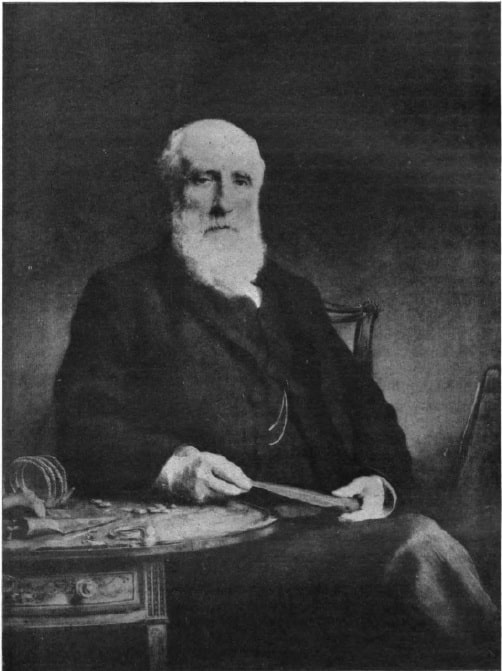
William Greenwell
As we enter further into October, and the nights grow longer, we come closer to Hallowe’en, where ghouls and demons are abroad. These have had little impact on the history of Durham School, of course, but horror literature has always had its fascination for the school pupil; in 1966, School House put on a production of Lord Dunsany’s 1917 chilling tale of a cursed ruby, A Night at an Inn, while there are no shortages of horror stories that appear in the pages of The Dunelmian or the student-written literary journal Satellite. The following account, however, features William Beckford’s 1786 French Gothic horror novel Vathek, which depicts a Arabian Caliph’s descent into madness and devil-worship, which proved to have a great impact on the life of the young William Greenwell.
William Greenwell was born in 1820 to William Thomas Greenwell; alongside his brothers Alan, Francis and Nicholas he attended Durham School when it was still located in Palace Green. He entered the school in 1833 and exited in 1836, although the conclusion of his education was marred. It was in 1836 that the French master, wishing to impress upon his pupils the exciting elements of the French language, lent some of senior pupils (including Greenwell) a copy of William Beckford’s Vathek, that gruesome tale of horror and Faustian bargains. The Headmaster at the time (Mr Matthew Buckle, who would go on to become the Vicar of Edlingham in 1839) heard that Greenwell had a copy of this shocking novel and immediately remonstrated with the boy, accusing him of introducing such scurrilous French literature to the school. Greenwell, upset, fled to his father’s house at Greenwell Ford, Lanchester, refusing to return to the School. While he had been set to enter University College, Oxford, this incident put his academic future at risk. By chance, however, Greenwell happened to meet Archdeacon Charles Thorp on the banks of the Wear; upon explaining his situation, Thorp invited him to attend Durham University, which had formed only four years prior in 1832. There had been at the time some disagreement and acrimony between Buckle and Thorp, such that the Archdeacon assured Greenwell that “I would rather have you without Mr. Buckle’s testimonials than with them”. While Buckle would later realise his apology and apologise to Greenwell, the incident would forever wed him to both to Durham and to the University.
To briefly sketch out Greenwell’s later career, he graduated the University with an MA in 1843, simultaneously joining the clergy and serving as the University’s Bursar 1844-1847. He became Chaplain in 1846, and served as minor Canon at the Cathedral from 1854. His various posts included Rector of St. Mary-le-Bow-the-Less from 1865 to 1918, and the Librarian of Durham Cathedral 1854 to 1909. His life’s passion was archaeology, becoming President of the Durham Archaeological Society and excavating and exploring several ancient barrows in Northumberland and the Yorkshire Wolds. The British Museum still has the Greenwell Collection, comprising his donated discoveries of sepulchral pottery, urns, and weapons. He published British Barrows in 1878, an analysis of the hundreds of Iron Age graves he exhumed in his career. Perhaps there is some echo of his adolescent fascination with Vathek in this widespread enthusiasm for ancient burial sites. His work in the area saw him honoured as a Fellow of the Royal Society in 1879,
Despite his acrimonious departure from Durham School, he remained part of the Durham School Board for a good portion of his life, and was a figure of familiarity for Durham pupils in his old age. The following account (submitted to the School’s archives in 1977) comes from H.F. Macdonald, a Caffinite from 1915 to 1921:
“I was ten years old [in 1912], and having been taught by an uncle to cast was beginning to show keenness on trout fishing; so my Father, who was himself an Honorary Canon of Durham, took me to see Canon Greenwell, who was then over ninety. I had never seen anyone so old and I came away with both the story and an impression of kindness that easily overleaped the eighty years between us. The story, as I remember it, was as follows: One day when he was fishing on the Tweed he noticed some olives on the water which he could not match from his fly-book. So he went to the local fly-dresser, described the fly, and asked him to make him a dozen. The man demurred, saying there was nos such fly; but Greeenwell insisted, and next day, using these flies, he took a record basket. That night a reception was held in the village hall. Someone raised his glass with the words: ‘Here’s to Greenwell’s Glory!’ Thus the fly got its name.”
Macdonald’s account his compelling, not least because Greenwell died only six years letter. An examination of an excellent memoir of Greenwell published in the 1918 volume of Archeological Aeliana confirms much of Macdonald’s statement. The incident itself would have occurred between 1850 and 1854, and the fly-dresser would have been a man named John Wright, who ran a profitable fishing-tackle business in Sprouston with his brother. The fly itself was described as made “with wings from the inside of a blackbird’s wing, and a body formed of Coch-y-Bondhu hackle tied with yellow silk”. The gentleman who coined the term ‘Greenwell’s Glory’ was identified as Mr Brown, a local schoolmaster in the Ovingham area.