
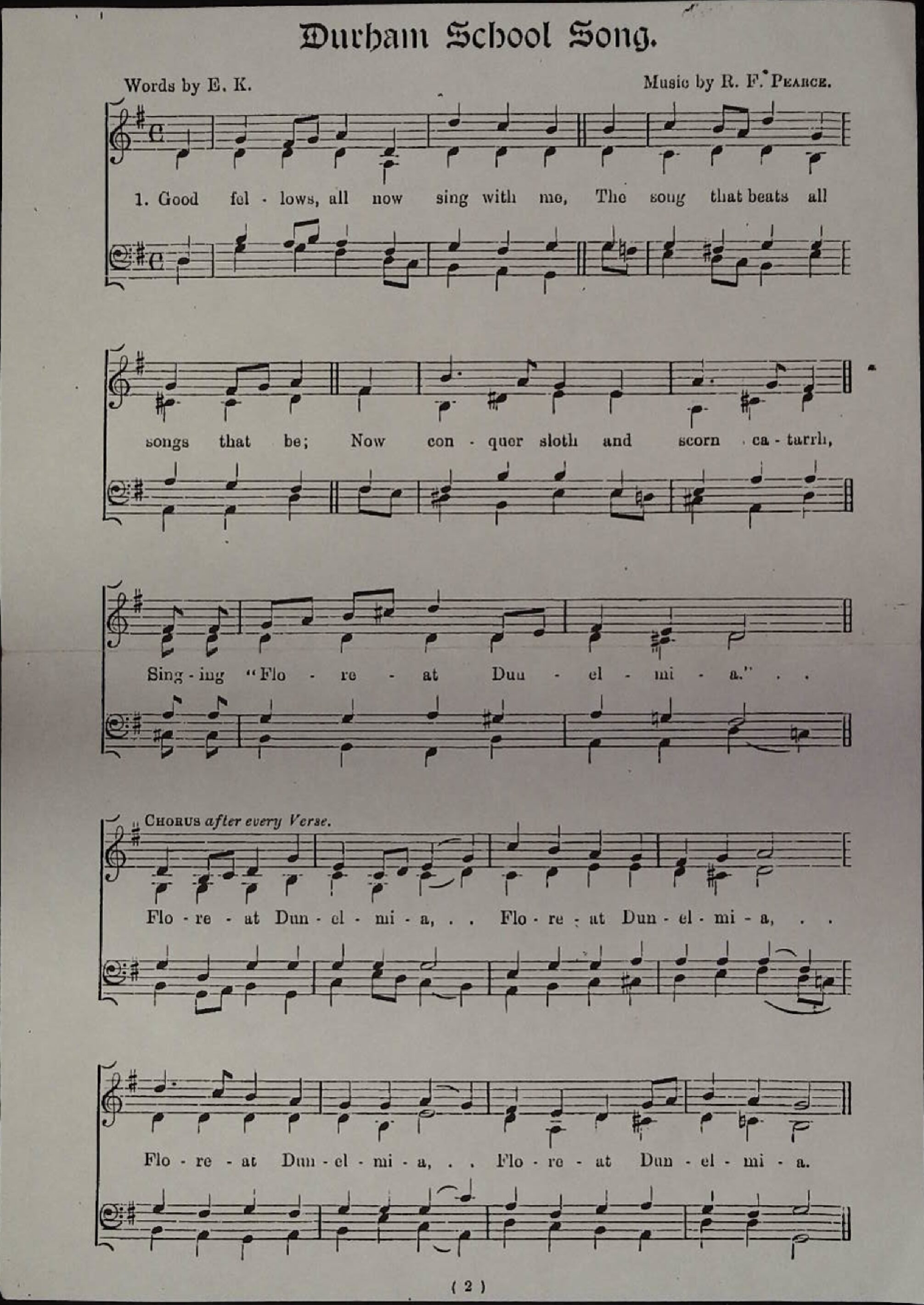
To any Old Dunelmian, the lyrics of the School Song – Floreat Dunelmia – must doubtless be etched into their memory. It may interest them to note the story behind the song, which can begin with a closer look at the lyrics and the history of the famous refrain:
Good fellows, all now sing with me,
The song that beats all songs that be;
Now conquer sloth and scorn catarrh,
Singing ‘Floreat Dunelmia’.
The opening verse is a rousing call to action, a desire for the ‘good fellows’ of the OD Dinner or speech day to join the singer in a rousing celebration. Of particular note is the request to “conquer sloth and scorn catarrh” – ‘catarrh’ refers to the build-up of mucus in the back of the nose and throat; those that have a cold, the song implies, may find the chorus difficult.
The need for a school song first arose in the 1st November 1890 issue of the Dunelmian, in which an anonymous correspondent only calling himself ‘Fiddlestick’ made the following observation:
“SIR , — I wish to call your attention to a matter which has long deserved attention—I mean the want of a School song. Year by year we hear the same old refrain, ‘Gaudeamus igitur,’ and I am sure that everybody would welcome a change. Can no means be found of providing the School with a song that it can really call its own ? I hope that this matter will be taken up by your readers.
–FIDDLESTICK’
A thousand years they’ve sung the same,
From days of Aldhune, holy name,
When clergy plied with pick and bar,
Singing ‘Floreat Dunelmia.’
The mention of “Aldhune, holy name” refers to Bishop Aldhun, the Bishop of Lindsfarne who in 995 received a vision that told him that the remains of Saint Cuthbert should be brought to Durham. He established the Cathedral and became first Bishop of Durham from 995 to 1019; in doing so he brought from Lindisfarne the tradition of learning and education that would last, as the song says, a thousand years. There is some evidence that a ‘Bishop’s Grammar School’ in the 12th and 13th centuries that would later be amalgamated into Durham School in 1414; it is not impossible that this could have been coeval with the construction of the Cathedral, and founded by Bishop Aldhun himself.
And boys athwart the cloister wall
Would pitch the medieval ball,
And, happier than the Padishah,
Sing ‘Floreat Dunelmia.’
The song is here referring to the long history of football (and, later, rugby) that existed in Durham and at the school. The “medieval ball” did indeed exist in Durham, with the Durham Bishopric Halmote Court Records containing reference to an early form of the game as far back as 1363. In 1579, the unlucky Durham resident John Bonkall was imprisoned for a week after playing football on a Sunday. Even the Shrove Tuesday festival at the nearby Sedgefield contains remnants of the modern game. The reference to “boys athwart the cloister wall” is surprisingly accurate, as evidence suggests that before 1844 football games were played on Palace Green before the move to the current site, with the ball game being played in the shadow of the Cathedral and (ghoulishly) amongst the gravestones. In an account given by 1841-1846 Durham School pupil John Mitchinson, he observes the ceiling of the Palace Green classroom “was profusely decorated with football stains.”
While the need for a school song was first raised by ‘Fiddlestick’ in 1890, a follow-up letter was submitted to the 15th July 1891 issue of the Dunelmian, in which he notes that no-one has yet volunteered a school song. The pseudonymous correspondent spoke to soon, as another writer named ‘E.K.’ notes that “It does not seem to be generally known that a School song was written some years ago,” before providing the words of the song for the first time in print. E.K. would later be identified as the author, although his modesty did not allow him to take full credit; when the song was published and sold some years later in 1894, it was under the initials of ‘E.K’.
And down below, where waters flow,
They learn in coracles to row,
While echo flung from crag and scar
Their ‘Floreat Dunelmia’.
Just as the history of Durham School Football is ancient, so too is rowing. Official rowing on the Wear can be traced back to the Regatta in 1834 and still further to 1815, when a procession of boats signalled the victory at Waterloo. The image of sixteenth or seventeenth century Durham School pupils in coracles described by E.K. is a compelling one, however.
E.K. himself refers to former Durham School pupil Eric Kirby, who was at the school from 1876 to 1882, and became Head Boy during his final two years. At school he was “distinguished by an amount of general reading and wide culture unusual among school boys,” to quote his later obituary. He went on to become Vicar of Sherborne from 1893 and Rector of Eaglescliffe in 1897. He was always, at heart, a poet. After leaving Durham School, he was frequently on hand to write the excellent ‘Epilogue’, the summary and interprentation of the year’s events which for some time (up until the Second World War) recited by pupils at the close of each Speech Day. To quote again from his Dunelmian obituary in 1904, “he had something deeper than a gift of facile expression; he had at least a spark, perhaps a good deal more, of real poetic genius”… If in his earlier days he had some of the ‘defects of his qualities’; if there was in the boy, and in the undergraduate, just a tendency to be dreamy, unpractical, unmethodical, it was a tendency which in later years was entirely conquered.”
Then forth they wandered through the land,
And served their king with wit or hand,
And made a name which nought shall mar,
Singing ‘Floreat Dunelmia’
In this verse the theme of the scope and breadth of ODs is introduced. Alumni wander “through the land”, serving their country through thought (“wit”) and deed (“hand”). This will be picked up in future verses.
If Eric Kirby wrote the school song, it was as a poem; there was no corresponding musical arrangement. It took a few years before a musical composition was found, but this eventually came with Robert Freeman Pearce, who attended the School from 1886 to 1894. Like Kirby, Pearce was Head of School during his final year, but compounded this with his time as School Monitor and in the Debating Society. Pearce wrote it in his final year, and it was first officially performed during the Speech Day on the 1st August 1894. It was also sung at a series of three concerts in October 1894, just before ‘God Save the Queen’. By December 1894, printed copies (“Words by E.K., Music by R.F. Pearce”) were available for 2d each.
So Hal the Eight, when he bore rule,
He spoiled the church, but spared the school;
Good Hal! – we’ll waft his praises far,
Singing ‘Floreat Dunelmia.’
Kirby here borrows William Shakespeare’s nickname for Henry V, ‘Prince Hal’, and gives it to his Tudor namesake King Henry VIII. While Henry VIII was responsible for the dissolution of the monasteries in 1536-1541 (i.e. “he spoiled the church”), he would follow this by re-founding the Langley Grammar Schools into Durham School in 1541 (i.e. “he spared the school”). ‘Good Hal’ is the eponymous King in the still-active ‘King’s Scholars’.
In 1993 an Old Dunelmian named Adrian Officer—who had attended school from 1940 to 1946—found an alternate, older version of the song. While the version we currently sing (and which Officer sang in 1940) is in G major, this other iteration was in A major, one tone higher, and carried with it various minor rhythmic differences in the chorus. This had belonged to Ernest Farrar (1885-1918), a composer and organist who was killed in action on the 18th September 1918. Interestingly, from 1904 he was an unattached member of Durham University, taking his music degree through a correspondence course; could he have then taken the opportunity to quietly revise Pearce’s score in order to make it more comfortable to a lower register?
For sons of Durham fill the earth,
And still, where’er they make their berth,
In Seaton Snook or Zanzibar,
Sing ‘Floreat Dunelmia’.
The line ‘In Seaton Snook or Zanzibar’ is, I would surmise, a rather clever jest on the part of Eric Kirby, in which he showcases the sense of humour and play that made his annual ‘Epilogues’ such enjoyable reading. The Durham School student wishing to visit Seaton Snook will be disappointed, as it no longer exists. It used to be a small village to the north of the Tees estuary, noted chiefly for its salt production. To the residents of the Victorian north East, it was the punchline to a joke, a quick reference to a town so minor to be irrelevant. In the 3rd January 1875 issue of the Northern Daily Mail—only a few years before Kirby’s composition of the School Song—there is a report of a meeting to decide on a new school in the Hartlepool or Stranton area. The Reverend E. Shaw ridicules the Mayor for his selection of buildings locations: “He thought they might just as well go to the Park at West Hartlepool, or, as people suggested, Seaton Snook. (Laughter).” Kirby is tapping into the same well of comedy: Durham School students (Kirby implies) can be find somewhere as local and uninteresting as Seaton Snook or as far-off and exotic as Zanzibar.
Seaton Snook limped past the closure of the local school in 1938 and the removal of the ‘Happidrome’ funfair in the late 1950s. By 1968, it had vanished, with no official reports containing the name. It is still true, however, that the School Song can be heard near and far. In the 150 years since the song was written, the strains of Floreat Dunelmia have indeed been sung throughout the world. It has been sung on the street of Coimbra in Portugal; during the bicentenary Bastille Day celebrations in Paris; in a night rescue mission on the Scottish mountain of Torr an Daimh; in a campsite adjoining the Mohne Dam in Germany; and, in The Three Tuns, Durham, during one of the first OD Dinners.
And so shall we, whate’er we be,
Whether a lawyer, lacking fee,
Or priest, or scribe, or bold hussar,
Sing ‘Floreat Dunelmia’.
During OD Dinners, tradition dictates that Old Dunelmians must all stand on their chairs when this last verse is sung. The precise origins of this tradition are, sadly, lost to time. Thomas Ledgard, who attended the school from 1929 to 1935, recalled the tradition as “climbing aloft to sing the school song”, which supports an account found elsewhere that when singing Floreat Dunelmia pupils were encouraged to sing it from the highest position they could reach in Big School. This custom was eventually discontinued to prevent “further injuries to pupils or property”. Ledgard would go on to bemoan that despite the fact pupils were encouraged to do climb up walls and onto tables, it was still a capital offense to be caught whistling the tune in the corridor. Perhaps the greatest encapsulation of this tradition came in 1985, when the song was sung at 35,000 feet during a flight from London to Moscow.