From the Archives (Michael Scot)
There is a section in Dante Aligheri’s Divine Comedy (written between 1308 and 1321) in which Dante, guided by the spirit of Roman poet Virgil, descends into the underworld and visits the Eighth Circle of Hell, or Malebolge. Within this are ten further circular ditches or ‘bolgias’, the fourth of which is devoted to Sorcerers. This is, as recounted in Canto XX of his initial volume Inferno, where Dante finds the wizard and astronomer Michael Scot. To quote Henry Wadsworth Longfellow’s 1867 translation:
“The next, who is so slender in the flanks, Was Michael Scott, who of a verity Of magical illusions knew the game.”
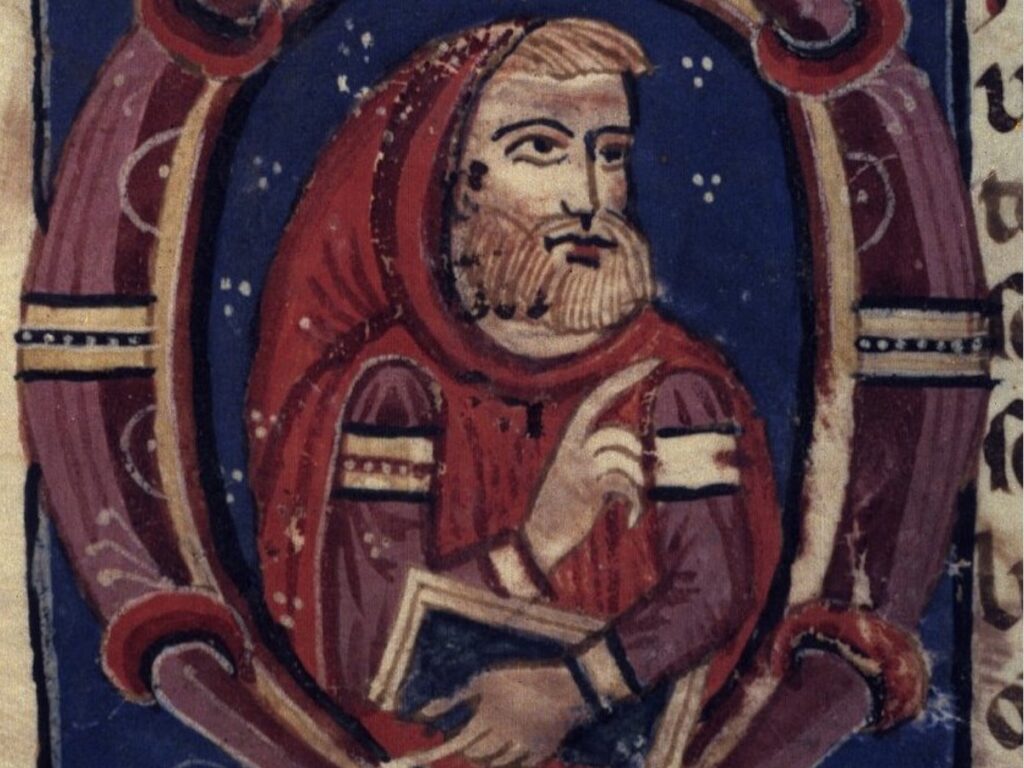
It is thanks to Dante’s eyewitness account that we know that Michael Scot is likely one of the few Durham School pupils to now be in hell. Michael Scot (1175-1232) would today be called a mathematician, philosopher and scholar, but by the legends of his time he was considered a powerful wizard, who—as Dante suggests— knew of “a verity of magical illusions”. If we know much about his his afterlife, therefore, his early life is painted in murkier shades.
Early accounts by individuals such as Roger Bacon and Giovanni Boccaccio only mention that Scot grew up in Scotland, leaving Durham out of the story entirely. John Leland’s De uiris illustribus, or On Famous Men (written in two phases in 1535-1536 and 1543-1546, at the same time as the Dissolution of the Monasteries) contains the first recorded reference to Michael Scot attending Durham School that I could find. To quote from James Carley’s excellent 2010 translation:
“Michael was given Scot as his surname, but not from his place of birth, for I have learnt from trustworthy informants that he was born and bred in the county of Durham and had his first taste of education there”.
The reference to Leland’s “trustworthy informants” is somewhat more tenuous than might be hoped for, but it is a matter of record that he visited the Benedictine Cathedral Priory Library at Durham in 1534, shortly before the Act of the Dissolution of the Lesser Monasteries in 1536. Michael Scot was born in 1175 and so likely attended the Bishop’s Grammar School, a school which existed long before the official formation of Durham School in 1414 but which nevertheless remains part of the school’s DNA. If Leland spoke to a member of Durham School on his visit in 1534, it is not unlikely that greater evidence of Scot’s link to the region was provided.
After leaving Durham, Scot went on to study at the Universities of Oxford and Paris, eventually making his way in 1200 to the court of Frederick II, the then King of Sicily. He would go on to make several studies of astronomy and alchemy, including his Abbreviatio Avicennæ (1210) and Liber Physiognomiæ (printed 1477). His translations of Aristotle into Latin proved fundamental to the reception of the philosopher in the Western world. His travels took him to Toledo, Bologna, Ireland and Italy, with his reputation for the arcane arts growing.
Within folklore and mythology, he was a powerful wizard. In Cumbria, he turned a coven of witches into stone; of the resulting stone circle, called Long Meg and Her Daughters, it is said that it is impossible to count their number, as they keep shifting and multiplying before you can finish. Another tale recounts that upon acquiring a powerful familiar, he was forced to find it tasks to complete; he told it to divide Eildon Hill into three and bind the River Tweed on its course with stone. Eventually, he told the spirit to spin sand into ropes, which he did; however, whenever the tide came up the sand would be swept away. It is said that the spirit is still toiling to this day. To quote Sir Walter Scott’s The Lay of the Last Minstrel (1805):
“…I could say to thee,
The words, that cleft Eildon hills in three,
And bridled the Tweed with a curb of stone.”
A tale in William Brockie’s Legends & Superstitions of the County of Durham (1886) involved how he offered to bring the tide up to the Northumberland village of Cambois. He persuaded villagers to run from Sheepwash to Morpeth, so that the tide (rolling and crashing behind them) could follow them up to its intended destination. The only condition was they could not turn back. Naturally one villager was afraid, and, Orpheus-like, turned back; the magic was broken and the tide stilled and retreated.
Michael Scot represents one of the few Old Dunelmians who exists in the fields of myth and literature rather than history, while Durham School itself is one of the few institutions that boasts a wizard on its alumni roll.